
Working with Space and Controlled Light
Indoor Photographer in Singapore
I assess the room, background and existing light, then adapt composition and equipment to the space so an indoor location becomes part of the portrait rather than merely shelter from the weather.
Indoor Photography Sessions in Singapore
An indoor session can take place at home, in a studio, hotel, office or another permitted venue. It provides shelter and greater environmental control, but every room presents different limitations in size, background, ceiling height and existing light.
I first consider what the photographs need to achieve and how much of the setting should remain visible. I can use available light or bring professional lighting according to the selected package, adapting equipment and camera position to the space rather than assuming every indoor location behaves like a studio.
Indoor photography can support personal portraits, families, branding and creative concepts. Access, privacy, power, furniture movement and permission for equipment should be settled before the session so the time can be used for photography rather than avoidable logistics.
What We Can Create
- Portraits:
Cosy home sessions, styled venue shoots or hotel room setups.
- Event Coverage:
From birthdays to meetings, indoors with expert lighting.
- Interior:
For designers, property listings or furniture brands.
- Studio Portraits:
Professional, clean looks with full lighting control.
Who Indoor Photography Is For
- Individuals and couples who prefer privacy or protection from changing weather
- Families who benefit from a familiar, accessible or child-friendly interior
- Professionals and businesses requiring photographs at a workplace or venue
- Content creators whose activity, styling or story belongs in an interior setting
- Clients who need more control over background, access, timing or lighting conditions
Your Goals for the Photoshoot
Gain greater control over privacy, access and weather.
Use an interior that contributes meaning, comfort or professional context.
Create consistent photographs with a planned background and lighting approach.
Work within the space realistically while protecting movement and equipment needs.
Clarifying these priorities helps me plan the session around what the photographs need to achieve. My guide to photoshoot goals can help you decide what matters most.
Where We Can Shoot
An indoor location can provide privacy, shelter and contextual surroundings. The available space, permission, furnishings and light determine what can be created there.
- Studio:
My private portrait studio or a suitable rental studio can provide controlled lighting, backgrounds and a repeatable setup.
- Home:
A familiar residential environment can support personal, family, lifestyle and intimate portraits.
- Hotel:
Rooms, suites and permitted shared areas can provide private, polished or architectural surroundings.
- Office or workplace:
Professional and operational environments can provide context for business, branding and environmental portraits.
- Other indoor spaces:
Cafés, bars, galleries, bookshops, stairwells, lobbies, showflats, pop-up venues and other suitable interiors can support a particular story or concept.
My on-location photography can take place at another indoor setting when access and photography are permitted. You can browse my guide to photoshoot places in Singapore.
Lighting Options for Your Photoshoot
The lighting approach is determined by the package you choose. The more basic option uses natural or available light, while other packages may include off-camera flash.
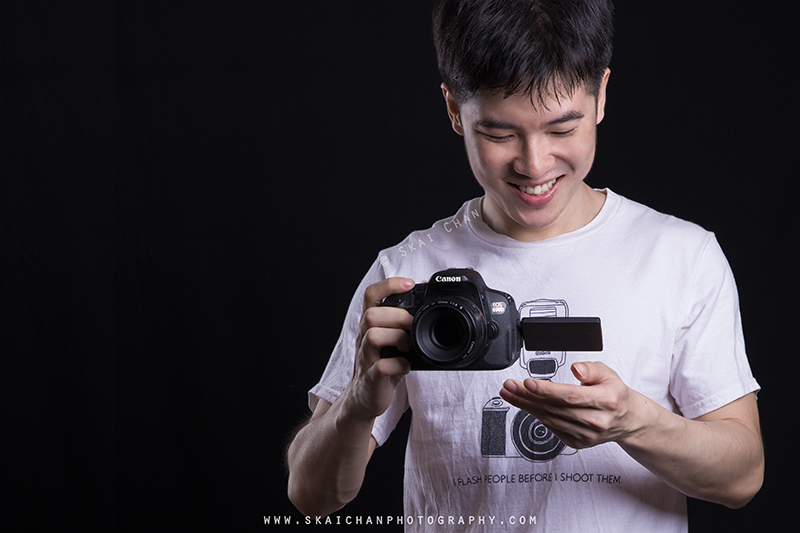

- Natural or available light:
Natural-light packages use suitable daylight or existing light at the location and usually allow us to move between positions with less setup time. If the conditions require additional support, I may use an on-camera speedlite, normally bounced from a suitable wall or ceiling.
- Off-camera flash:
You can choose a package that includes off-camera flash or arrange it as a paid add-on where offered. The standard setup uses one light; additional lights cost extra.
- Advance arrangement:
Off-camera flash must be arranged before the shoot so that I can plan the equipment, timing and location requirements. If conditions prevent the planned setup, I may use an on-camera speedlite instead, bouncing it from a suitable wall or ceiling where possible or using a larger flash modifier when there is no suitable surface.
For a practical comparison, read my guide to flash and natural-light photography.
Why Choose Skai for Indoor Photography
Indoor locations offer privacy, convenience and personal context, but their light and space can be restrictive. I assess the actual room and build the photography around what it can support instead of assuming every interior behaves like a studio.
- Lighting Adapted to Difficult Interiors:
I recognise mixed colour, dark corners and unflattering overhead light, then choose the camera position and package's lighting approach accordingly. I can use suitable available light or arrange flash where the ceiling, floor area and venue rules make the setup practical.
- Useful Composition in Limited Space:
I work with walls, furniture and room depth to find clean angles without pretending that a small interior can accommodate every pose or equipment setup.
- The Environment Can Add Meaning:
A home, workplace or hotel can explain something about the person or purpose. I include that context deliberately rather than allowing background clutter to dominate.
- Flattering Portraits Within Real Rooms:
I consider facial light, body angle, expression and the surrounding furniture together, instead of concentrating only on making the room look attractive. This keeps the person visually important while allowing the indoor setting to remain part of the portrait.
- Preparation Based on Real Conditions:
Reference photographs and location details help me anticipate access, power, ceiling colour, space and background issues before the session.
If you are considering an indoor location, send me photographs and details of the space. You can also learn more about why clients choose Skai Chan Photography.
Reviews
Clients' Testimonials
"Engaged Skai for a 4-hour shoot. He was very accommodating with locations and was happy to complete the shoot even when it ended late. Very kind and intelligent photographer, the photos turned out great. Would recommend and engage again"
- Leonard Lye
Pricing & Packages
Essential
SGD 600
Duration1.5 hr
Final images15 photos (basic edit)
LightingNatural light
Wardrobe3 outfits
Optional Add-ons
Extra time
$100per additional 30-minute block
Extra photo
$30each · basic edit | $80each · advanced edit
$100per 30 minutes of booked coverage
Classic
SGD 800
Duration1.5 hr
Final images15 photos (basic edit)
LightingOff-Camera Flash
Wardrobe3 outfits
Optional Add-ons
Extra time
$100per additional 30-minute block
Extra photo
$30each · basic edit | $80each · advanced edit
$100per 30 minutes of booked coverage
Signature
SGD 2000
Duration1.5 hr
Final images15 photos (adv edit)
LightingOff-Camera Flash
Wardrobe3 outfits
Optional Add-ons
Extra time
$100per additional 30-minute block
Extra photo
$30each · basic edit | $80each · advanced edit
$100per 30 minutes of booked coverage
When choosing a package for indoor photography, the most suitable option depends on the session duration, number of people, number of final photographs, location, lighting requirements, level of editing and whether the photographs are for personal or commercial use.
Studio or venue hire, location permits, travel, special props or styling, additional lighting or manpower, advanced retouching, urgent delivery and other optional services may involve additional charges where relevant. I will discuss any relevant requirements and costs with you before the session is confirmed.
Skai the Indoor Photographer
 Hello! I'm Skai, a professional indoor photographer in Singapore, and yes, I've become quite adept at turning even the darkest, most cluttered spaces into something worthy of a photo frame. If it's an indoor space with barely any light, I'm your guy. Over the years, I've developed a talent for making tricky lighting situations work in my favour-and turning what could've been disastrous into something beautiful.
Indoor photography has been a bit like a boot camp for me. Unlike shooting outdoors, where the sun does half the work, indoors is where the real magic (or frustration) happens. Low light? Shadows? A flickering bulb? Bring it on. These challenges forced me to become best friends with my flash, teaching me to use lighting in ways I'd never imagined. Without natural light around to play hero, I was able to focus purely on the effects of artificial lighting-one bounce off a ceiling, and suddenly everything looked much better, including my career prospects.
Funny enough, my journey started with taking truly unremarkable, let's say "ugly", event photos during family gatherings. Most of those were indoors, where I didn't even realise my shots were underexposed. Back then, I thought auto mode meant "photographer mode"-turns out, not so much. If only I had known that my photos resembled more of a dark abstract art piece than actual memories.
Fast forward to when I finally got my hands on a DSLR and started shooting in RAW-everything changed. Add in a speedlite bouncing light off walls and ceilings, and suddenly my photos took a great leap forward, like they'd been through some sort of glow-up. Post-production became my playground and I soon realised that indoor photography didn't have to be a nightmare-it could be an opportunity. Whether I was shooting portraits at someone's home, in an abandoned building or even at a dimly lit hotel lobby, each location pushed me to experiment and refine my skills.
Now, when I walk into a room with bad lighting, I don't flinch. I just smile, reach for my flash and know that it's about to look a whole lot better-both for me and for you.
Want to know what shaped the way I work today? My photography journey has taught me far more than cameras and lighting.
Discover My Photography Journey →
Understanding Indoor Photography
What Is Indoor Photography?
Indoor photography refers to photography carried out inside a building or other enclosed space. In the context of my portrait services, this can include photographing people in studios, homes, hotels, offices, restaurants, event venues and many other indoor locations. Unlike studio photography, indoor photography doesn't necessarily mean working in an environment designed specifically for photography.
Different indoor locations can produce very different photographs. A photography studio may provide plain backgrounds and plenty of room for lighting equipment, while a home can provide a more personal environment. An office can add professional context, and a hotel, restaurant or other venue may be selected because its interior suits a particular concept. The location therefore isn't simply somewhere to escape Singapore's weather; it can contribute significantly to the appearance and meaning of the photographs.
One of the main considerations indoors is lighting. Some spaces have large windows and useful natural light, while others may be dim or illuminated by a mixture of ceiling lights, lamps and daylight with different colour temperatures. Depending on the location, the intended photographs and the photography package, I can work with the available light or introduce professional lighting to gain greater control over how the subject is illuminated.
Space can be just as important as light. Small rooms, low ceilings, fixed furniture, mirrors, clutter and narrow working distances can restrict where I position the subject, camera and lighting equipment. A location may look spacious enough for everyday use but become surprisingly restrictive once I need sufficient distance for the composition and additional room for lights and modifiers.
Indoor photography also doesn't automatically mean that the environment is fully controlled. Public and commercial venues may have other people moving through the space, restrictions on professional photography or limitations on where equipment can be placed. Homes and offices have their own practical constraints, while dedicated studios generally provide greater control over the shooting environment.
For me, the advantage of indoor photography is the enormous variety of environments available. Rather than treating every indoor location like a studio, I consider the existing space, background, light and restrictions first, then decide how best to work with or modify those conditions for the photographs we want to create.
Related locations and photography: Studio Photography, Home Portrait Photography, Hotel Photography, Office Photography, On-Location Photography and Outdoor Photography.
Why Choose An Indoor Photoshoot?
Indoor photography offers comfort, privacy, and protection from weather while allowing a wide variety of creative possibilities.
Indoor photography can offer:
- comfortable shooting conditions
- protection from rain and heat
- greater privacy
- controlled environments
- consistent scheduling flexibility
Many indoor locations can be transformed into beautiful photographic spaces with thoughtful lighting and composition.
Portrait Photography Guides & Resources
Explore these guides to help you plan your portrait photoshoot, understand different photography approaches and know what to expect throughout the process.
Planning Your Photoshoot
- What Do You Want From Your Photoshoot?
- Portrait Shoot Preparation Guide
- How to Choose the Right Photoshoot Duration
- How to Plan Your Wardrobe With Your Photographer
- All Photoshoot Places in Singapore
- Best Locations for Portrait Photography in Singapore
- How to Slim Down for a Photoshoot
- Should Your Partner or Family Tag Along to a Photoshoot?
- Wet weather photoshoot in Singapore
Understanding Photography
- Flash vs Natural Light Photography
- Lifestyle vs Fashion Photography
- Outdoor, studio, indoor photography comparison
Photoshoot Process
FAQ
Location, Space & Preparation
Lighting, Permission & Privacy
For general questions about booking, payment, preparation, editing, delivery and privacy, visit the main photography FAQ.
Ready to Book Your Indoor Session?
- View FAQs
- View Booking Process
Explore the Possibilities
Find Your Photography Session
Browse every portrait, commercial, event and specialist photography service available.
 Scan QR to visit this website
0%