
Photoshoot Album
Halloween 2026: Still Hanging On
A conceptual self-portrait series about my ongoing Tengah CCS nightmare, its personal impact and my determination to keep going.
Halloween 2026: Still Hanging On
Another Halloween, another chapter of my Tengah Centralised Cooling System (CCS) nightmare. What was supposed to be the beginning of a new chapter in my photography career has turned into nearly three years of repeated cooling system problems, disrupted plans, emotional exhaustion and an ongoing struggle to move forward. I had hoped that by now, I would be spending most of my time developing my photography instead of dealing with the consequences of a cooling system that has caused me so much trouble.
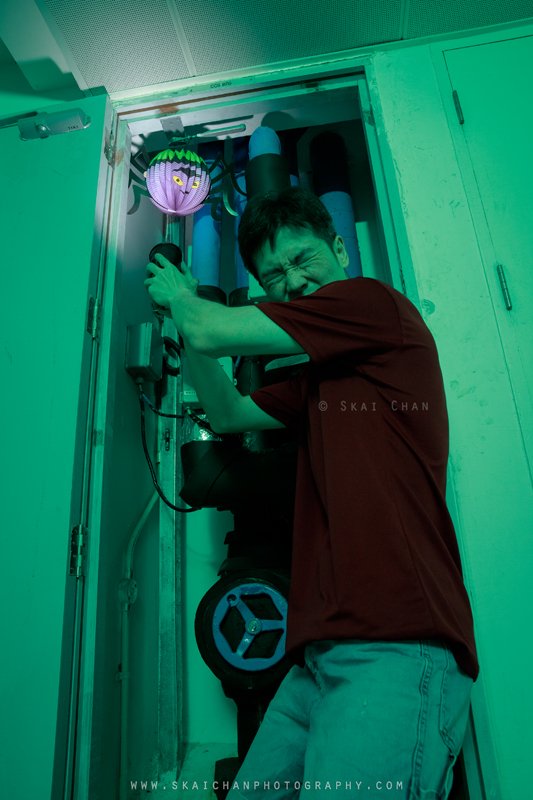
For Halloween 2026, I decided to turn my experience into another conceptual self-portrait series. Unlike my earlier Halloween shoot, which focused on the waterfall incident, this project explores the wider impact of the prolonged ordeal on my life, photography career and state of mind. The photographs combine theatrical lighting, Halloween decorations, multiple versions of myself, levitation, documentary images and a little dark humour. Some scenes are deliberately exaggerated, but the experiences behind them are very real.
I call this series Still Hanging On because that is exactly how I feel. The battle isn't over, and I don't know whether I will ever achieve the outcome I have been fighting for. Nevertheless, I am trying to regain my strength, rebuild my career and continue with my life.
The Real Horror Behind the Photographs
A Home Studio That Was Supposed to Change My Life
For years, I struggled to find a reliable place to practise and develop my photography. Before moving into our Tengah home, my wife and I were renting a room, and I didn't have a permanent studio of my own. I had already received enquiries from clients who wanted studio photography, but I couldn't always accommodate them. Having my own home studio was supposed to change that. I wanted to create portrait samples, experiment with different lighting techniques, produce personal projects and marketing videos, and develop new ideas that could attract more suitable clients. As a photographer who handles everything from enquiries to shooting and post-production, having a dependable workspace would have made an enormous difference.
I had given myself approximately one year to push my photography business forward. With a proper studio, the necessary equipment and the demand I had already seen from potential clients, I believed I had a realistic opportunity to improve my income substantially. There was also a deeply personal reason for that ambition. My wife was already at an age (not going to disclose the figure) when we had to take the increasing risks associated with pregnancy and childbirth seriously. Before our marriage, we had agreed that we would consider having a child if I could establish a better financial position. I wanted to prove that I was capable of providing that stability, and I knew we couldn't postpone the decision indefinitely.
Unfortunately, the repeated CCS problems consumed the very period of time I had set aside to build that future. The delays were not merely inconvenient. They affected my concentration, confidence, ability to accept work and belief that I could make meaningful progress. Instead of spending my time creating photographs and building my portfolio, I found myself dealing with leaks, repairs, uncertainty and repeated disappointments. I have written more about my earlier struggles to establish a suitable workspace in The Story Behind My Studio.
The Endless Cycle of Repairs and False Hope
I kept thinking to myself, "How can an air-conditioning system be so cocked up? Surely, the next repair would be the last one?"
Each time the CCS was repaired, I hoped that the nightmare had finally ended. I imagined myself getting back to photography, developing my portfolio and taking my career to the next level. I was willing to wait a little longer because I believed that once the problem was resolved, I could finally concentrate on the work I loved. Unfortunately, the problems kept returning. After repeated attempts involving the trunking and insulation, my confidence in a lasting resolution deteriorated. Every failure meant another round of reporting, inspections, packing, scheduling, repair work, touch-ups and cleaning.
Preparing for repair work was exhausting in itself. At the time, we had relatively little storage, so many of our belongings were exposed or stored around the home. We had to move things, protect our privacy and supervise the work because the workers were operating in a home that we were already living in, rather than an empty renovation site. Interior renovation packages often include post-renovation cleaning because any renovation work would be dusty. Just imagine moving into a new home and repeatedly having to prepare it for renovation work, then clean everything up afterwards. On one occasion, the workers finished at around 11 pm, and I spent another couple of hours cleaning. When the repair failed again, all that preparation and disruption had to be repeated.
I need considerable concentration to work effectively, especially because I usually personalise photography sessions for my clients. Planning concepts, such as this Halloween-themed shoot, communicating with clients, preparing lighting setups and editing photographs all require focus. However, the CCS uncertainty became so mentally draining that I often felt too exhausted even to reply to enquiries. It was as though my brain had become blocked. I found it difficult to think creatively or make plans when I couldn't be confident that the same problem wouldn't return and disrupt everything again.
When the Problems Began Affecting My Clients
One of the most distressing incidents involved a confirmed studio photoshoot with a fitness client. The CCS started leaking again, forcing me to postpone the session. The arrangement involved not only the client but also a makeup artist, and the client was at an ideal stage of physical preparation for the photographs. Trust and reliability are extremely important to me as a professional photographer, and I know how much preparation clients may invest in a shoot. Having to postpone an assignment because my own studio was unreliable was deeply upsetting, especially when the circumstances were beyond my control. We eventually completed the photoshoot after the client's holiday, with the bucket from the famous Giant mop set positioned beneath the air-conditioner to collect leaking water. It was hardly the professional studio environment I had envisioned.
In another case, a prospective client was keen to arrange a fitness studio shoot several months ahead. However, because I couldn't be confident that the CCS problems would be resolved, I didn't dare to collect a booking fee and commit to the date. Although we had discussed the shoot, I didn't maintain contact with her as the date approached, and she eventually stopped responding. I cannot know why she disappeared, but the uncertainty had already prevented me from handling the opportunity as I normally would.
These were not the only consequences. I substantially reduced the photography work I could take on while trying to cope with the situation. My business plans stalled, my savings were affected, and the home studio that was supposed to create opportunities became another source of anxiety. I even had to display a notice on my website explaining that studio photography was unavailable because of the cooling system problem, so that clients would stop approaching me for something I couldn't confidently provide. It was embarrassing and frustrating to keep repeating the same explanation. After all, how many people would expect a new home's air-conditioning problem to remain unresolved for so long?
Later, I changed it to a warning to explain that air-conditioning was unavailable in my studio. Even then, enthusiastic clients would occasionally approach me for studio shoots without having read that information. When I eventually highlighted the lack of air-conditioning, some changed their minds. Each of these encounters reminded me of how much the CCS situation had affected my ability to serve clients and earn an income. I felt powerless against a large corporation while trying to keep my small photography business going.
The Fourth Management Meeting and Its Aftermath
After more than a year of trying to deal with the CCS problems, I was mentally exhausted. I had repeatedly explained the situation, documented the failures and spent considerable time dealing with the consequences. During earlier discussions with SP's management, I felt that my concerns had been dismissed and that I was being treated unfairly. By the time SP requested a fourth management meeting after my story received mainstream media coverage, the prospect of having to explain everything again was extremely distressing. I couldn't understand why I still had to repeat matters that had already been brought to their attention.
I was sceptical about the usefulness of another meeting, but SP had asked to hear my compensation request, so I agreed to meet them again. During the discussion, I struggled to organise my thoughts and communicate everything I wanted to say. I was close to breaking down. Lawrence Pek, who attended the meeting, helped me express my concerns when I found it difficult to do so myself. I had spent so much time and energy dealing with the situation that even talking about it had become emotionally draining.
Seeking Help from My MP
I subsequently met my Member of Parliament, Dr Choo, who told me that she had secured a better offer than what SP had previously proposed: a full refund and reinstatement of my home. However, she did not disclose the details of the improved offer to me. I therefore had no way of assessing how much better it was or what it might have covered. Meanwhile, SP rejected my list of compensation requests without proposing an alternative that addressed the losses I had described. I found myself in a confusing position: I was told that a better arrangement had been discussed, yet I still didn't know what it involved or how it would help me move forward.
Dr Choo also introduced me to Melvin, the chairman of the Residents' Network for my estate. During our conversation, he told me that other CCS users had previously received full refunds from SP. I considered his account credible because of his involvement in the estate's community network, although I have not independently verified the details of those individual cases. Hearing this made me question why my own case had taken so long to reach the point of a full-refund offer.
Why a Full Refund Wasn't Enough
I had repeatedly allowed repair attempts because I wanted the cooling system to work as intended. Every time SP proposed another solution, I had to decide whether to give them another chance or abandon the system altogether. I kept hoping that the next repair would finally succeed because I desperately needed to use the home studio I had worked so hard to establish. Looking back, I felt that I had given SP more than enough opportunities, including five repair attempts, to resolve the problems. Meanwhile, the repeated disruptions continued to affect my photography business and personal well-being. Had I been able to obtain a satisfactory resolution much earlier, I would have made alternative arrangements and started rebuilding my life sooner.
SP eventually offered me a full refund, but declined to provide the additional compensation I sought for the consequences of the prolonged ordeal. To me, refunding the money paid for a system that had repeatedly failed was fundamentally different from compensating someone for the time, work opportunities and peace of mind lost while trying to get that system repaired. A refund could help me move on from the CCS itself, but it couldn't restore the months and years I had spent dealing with its problems.
What I found particularly ironic was the difference between how cancellation costs and residents' losses appeared to be treated. Under the CCS cancellation arrangements I had encountered, homeowners could be required to bear a substantial portion of the stated cancellation loss, including a 50% component. Yet when I sought compensation for the disruption and losses I had experienced because of the repeated failures, SP declined my requests. I couldn't understand why the financial consequences of cancelling a service could be calculated and imposed on homeowners, while the consequences suffered by affected residents seemed so much harder to acknowledge.
I was also troubled by the timing of the fourth meeting, which took place only after my experience had attracted wider public attention. I wondered whether the meeting was intended primarily to demonstrate that SP had engaged with me, rather than to resolve the full extent of my concerns. That remains my interpretation, not something I can establish as SP's motive. Nevertheless, the repeated delays, unsuccessful repairs and eventual rejection of my compensation request left me feeling bullied and powerless.
What made the situation even more frustrating was seeing SP publicise charitable initiatives and other positive stories about its work, including promotional content on social media. I recognise that charitable activities and customer compensation are different matters, but the contrast was difficult for me to accept. While I was struggling financially and emotionally, I felt that the harm caused by the prolonged CCS problems was not receiving the same attention as the organisation's public image. I would have preferred to see affected residents receive timely, transparent and fair resolutions without having to spend years pursuing them.
I intend to document the fourth meeting and the subsequent correspondence in greater detail in my Tengah CCS article, which contains the broader history of the problems and my attempts to seek a resolution.
The Personal Consequences I Never Expected
I eventually sought psychological support even before the fourth management meeting took place. During my first appointment, I broke down in tears while telling a nurse that I feared I might no longer be able to afford to have a child with my wife. That was one of the most painful consequences of the entire experience. I had hoped that developing my photography business would help us make an informed decision about starting a family. Instead, I spent that precious period dealing with repeated failures, financial uncertainty and deteriorating mental well-being.
I'm not claiming that the CCS situation alone determined our family circumstances, but I know how much it disrupted the professional progress I was working towards and how deeply that affected my confidence in the future. To me, the real horror was never just water leaking dangerously from an air-conditioning system. It was watching time, opportunities and peace of mind slip away while I struggled to get back to the life I had planned.
Living Without Air-Conditioning Through the Heat and Haze
Another consequence that I haven't emphasised enough is that my wife and I have been living without air-conditioning since the CCS waterfall. We've endured Singapore's hottest and most humid periods, including uncomfortable nights when the heat made it difficult to rest. Even during episodes of haze, we couldn't simply close the windows and switch on the air-conditioning to make our home more comfortable.
It is particularly frustrating because we moved into a new home expecting to enjoy a reliable cooling system. Instead, we've had to adapt our daily lives around its failure. I've also had to explain to prospective photography clients that my home studio is not air-conditioned, which has further limited my opportunities.
We've managed to get through the heat, humidity and haze, but that doesn't mean the situation has been acceptable. Every uncomfortable day is another reminder of how long this ordeal has continued.
And somehow, we're still hanging on.
The Story and Meaning Behind the Photographs
I arranged the 20 photographs to follow an emotional journey, beginning in the corridor outside my home and ending inside the studio space I had hoped to use for my career. The first nine photographs use Halloween imagery to express my state of mind, the next six document the actual CCS riser, and the final five explore my efforts to recover and continue.
Photos 01–03: A Lost Soul
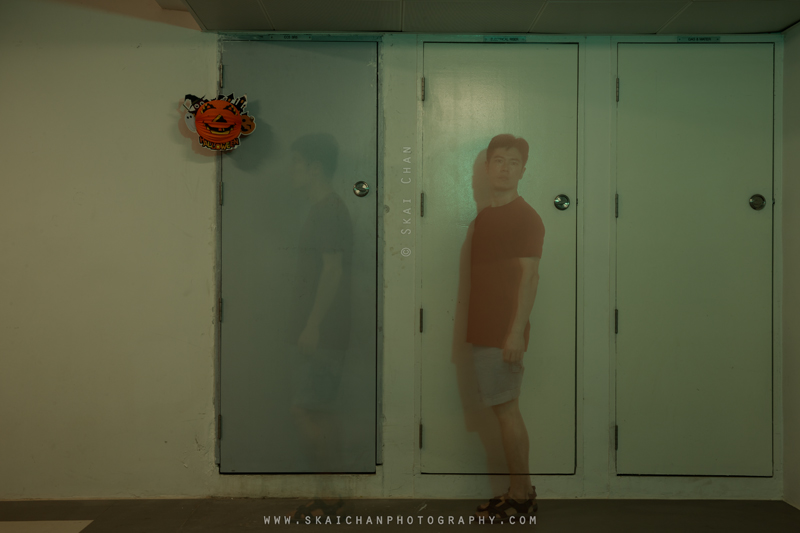
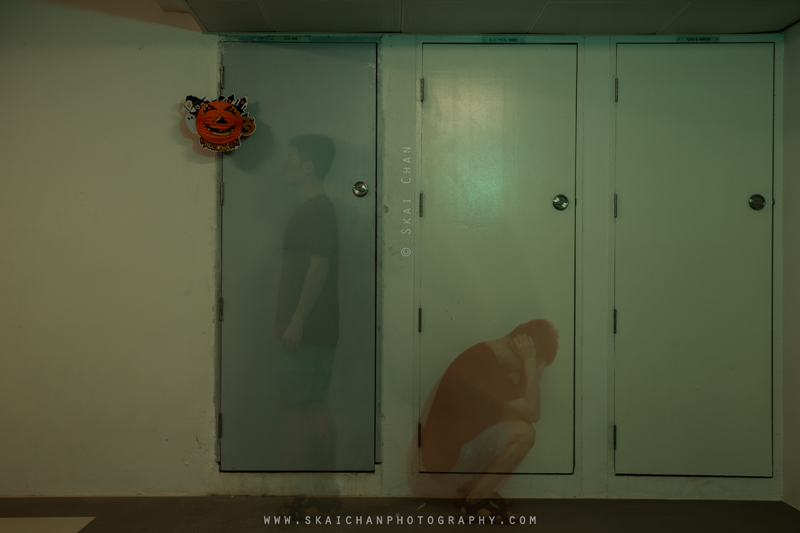
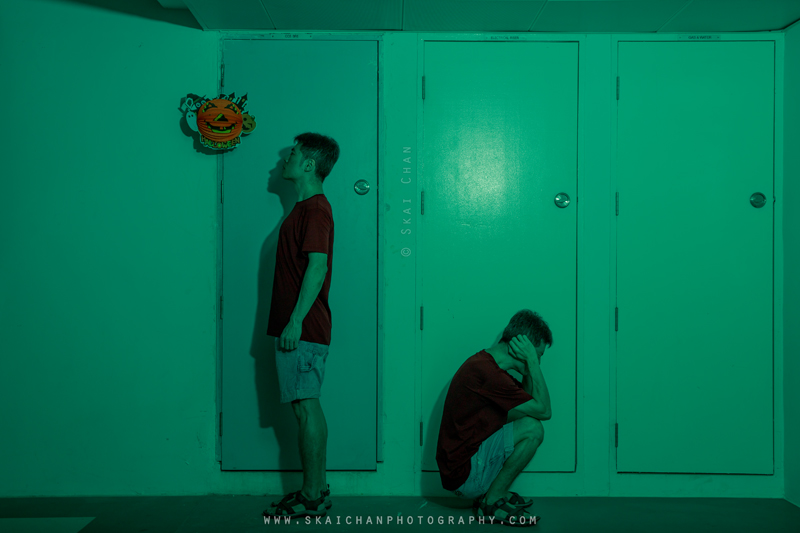
The opening photographs show ghostly versions of myself moving around the CCS riser. The blurred figures represent confusion, repeated attempts to move forward and the feeling of being trapped in a situation that never seems to end. Each unsuccessful repair gave me another reason to hope that I could finally restart my photography plans, yet I repeatedly found myself back at the same point. In the third photograph, two more clearly defined versions of me appear together, with one standing while the other crouches in distress. I wanted to express the contrast between the part of me that still tries to function normally and the part that has become overwhelmed by the ordeal.
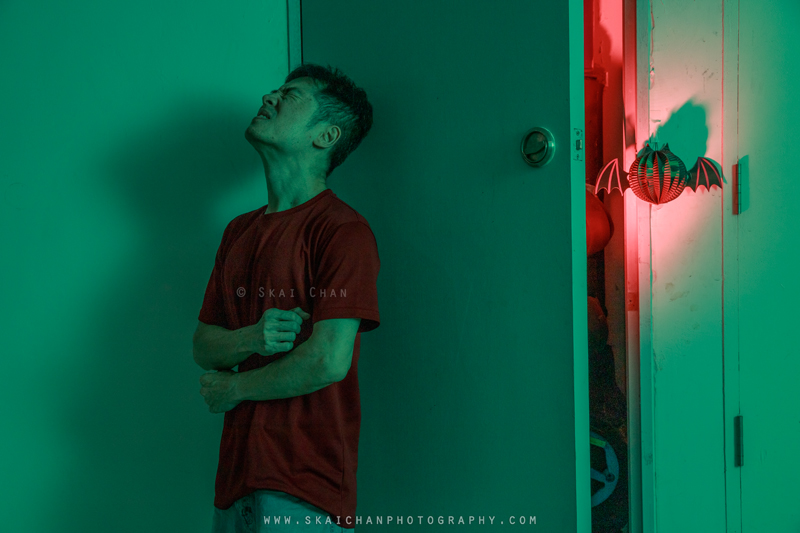
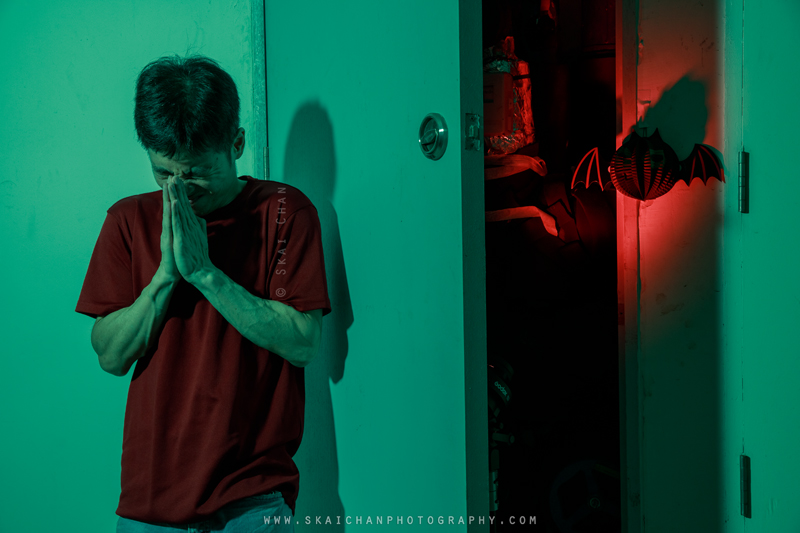
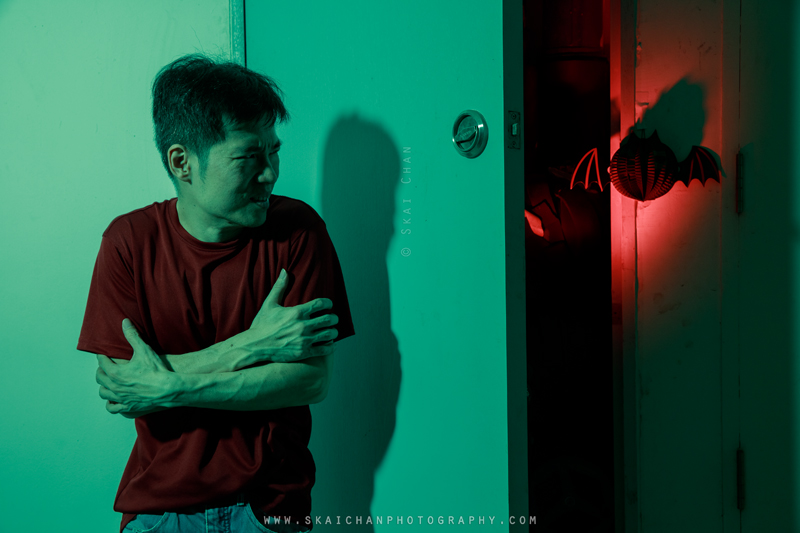
Photos 04–07: Behind the Door
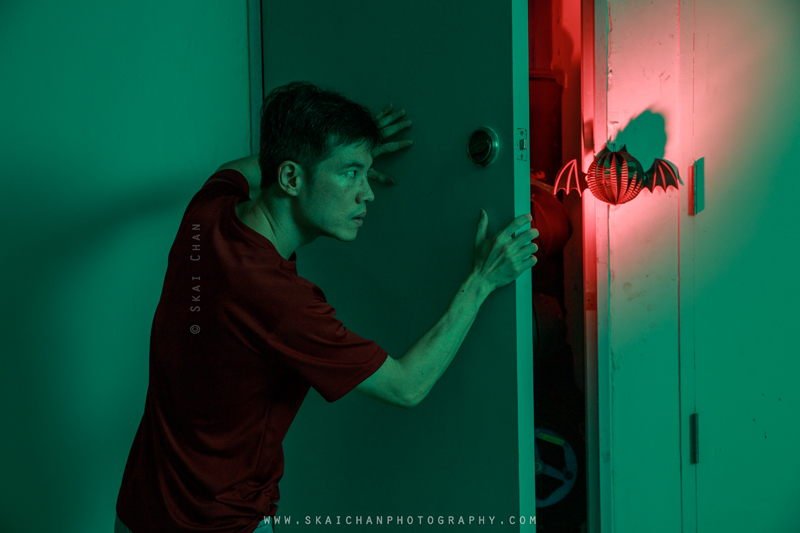
The partially opened CCS riser becomes the entrance to a Halloween nightmare. A bat appears, while I react with suspicion, exhaustion, desperation and fear. These expressions reflect how my feelings changed after repeated repair failures. Initially, I wanted to understand what was happening and believed that the problems could be resolved. Over time, every new sign of trouble made me increasingly anxious about what might happen next. The bat is a fictional antagonist rather than a literal representation of any individual, providing a playful Halloween symbol for a situation that had become frightening and difficult to escape.
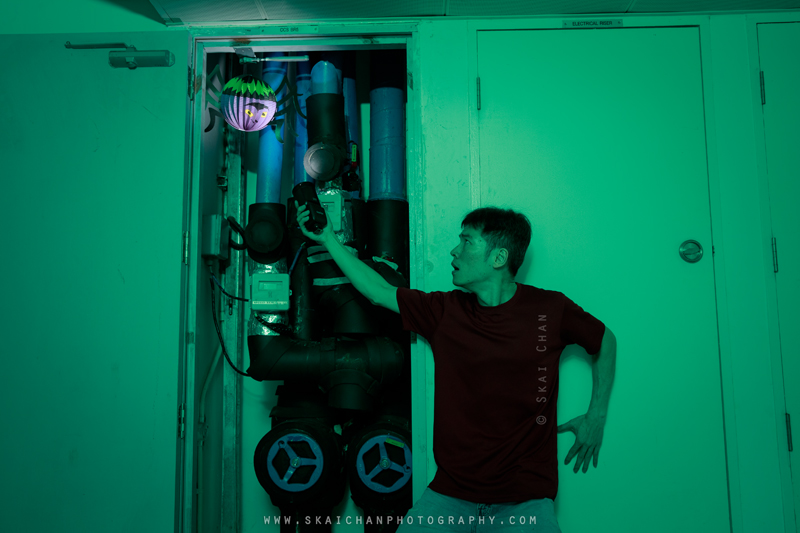
Photos 08–09: Confronting the Nightmare
Instead of continuing to hide from the problem, I approach the opened riser with a camera flash. The light represents my attempts to investigate, document and expose what has been happening. As a photographer, lighting is one of my most important tools, so I deliberately used a flash to connect my profession with the struggle I have been facing. The same equipment I normally use to create portraits becomes a symbolic tool for confronting the nightmare. However, this is not a victory scene. It represents the effort required to keep asking questions and seeking accountability, even when I am already exhausted.
Photos 10–15: The Real Horror
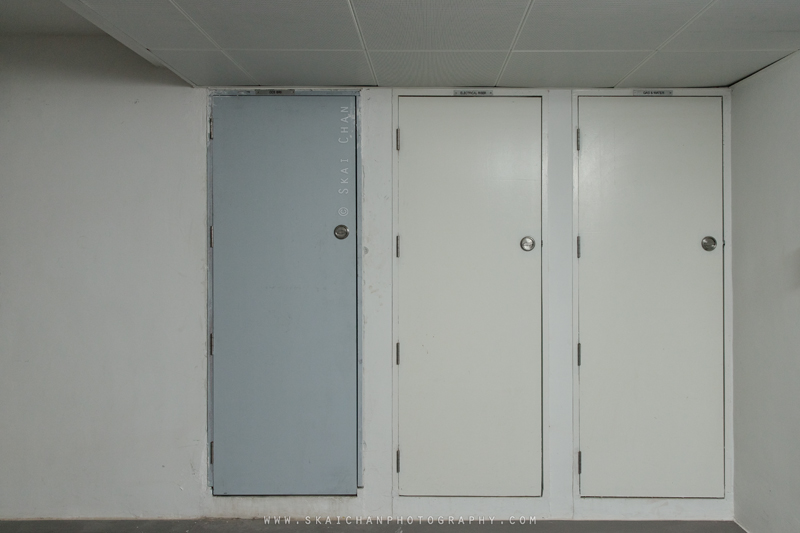
You may have noticed that the CCS riser door is grey, unlike the neighbouring white utility doors. It wasn't originally this colour. The previous door had deteriorated around its bottom edges, possibly due to the persistent condensation inside the riser, and was eventually replaced with this grey one. I don't know whether the replacement was also intended to reduce cold air escaping from the riser, but I find it troubling that a door in a relatively new building had already deteriorated to the point of requiring replacement within three years.
Having to replace a deteriorating CCS riser door within three years also raises questions about the long-term durability and maintenance of the system.
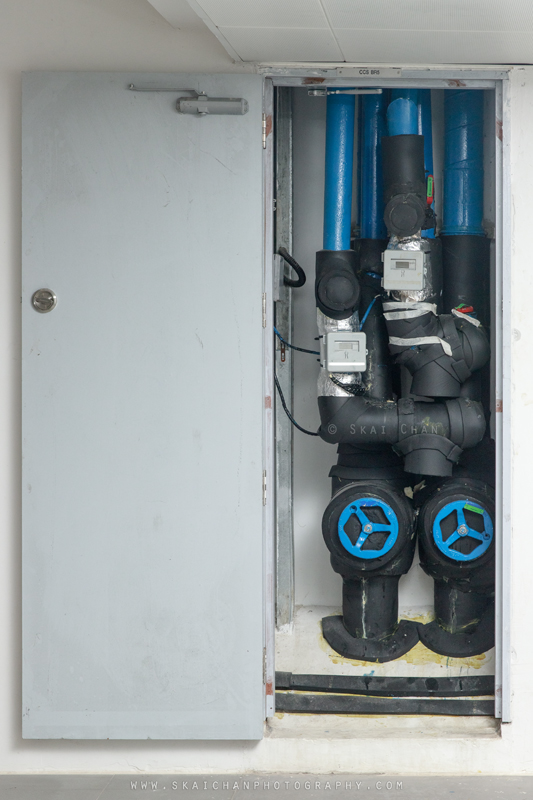
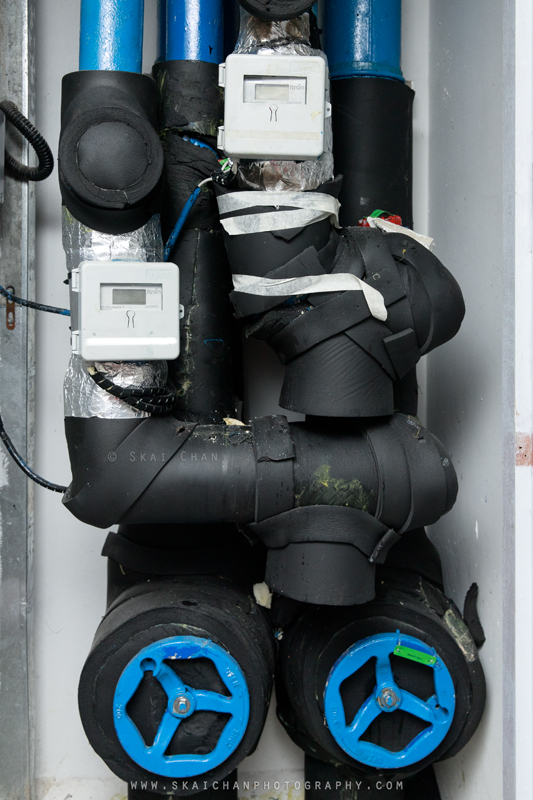
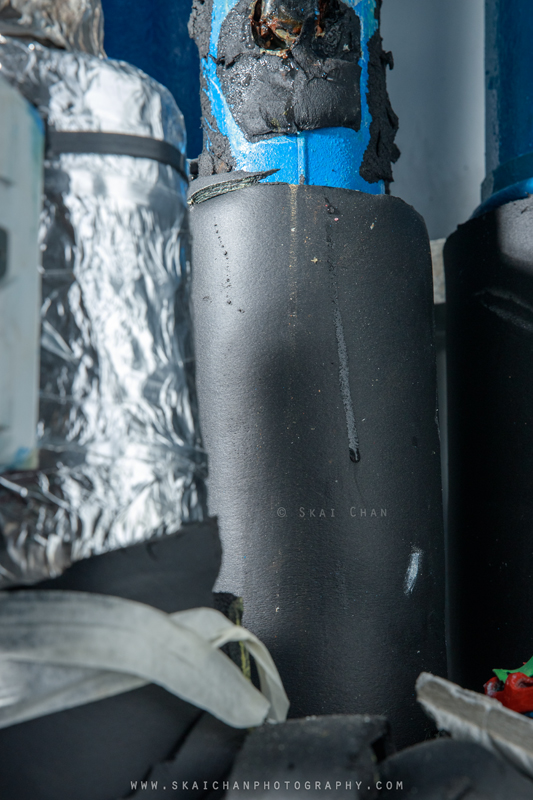
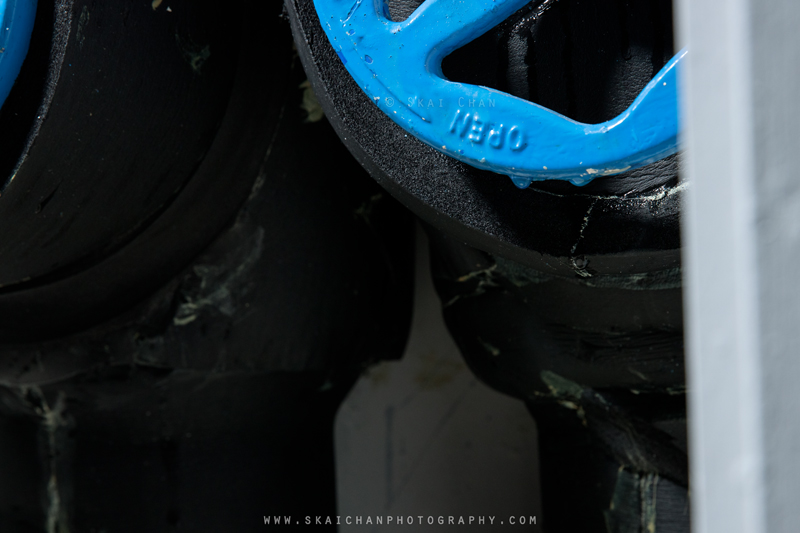
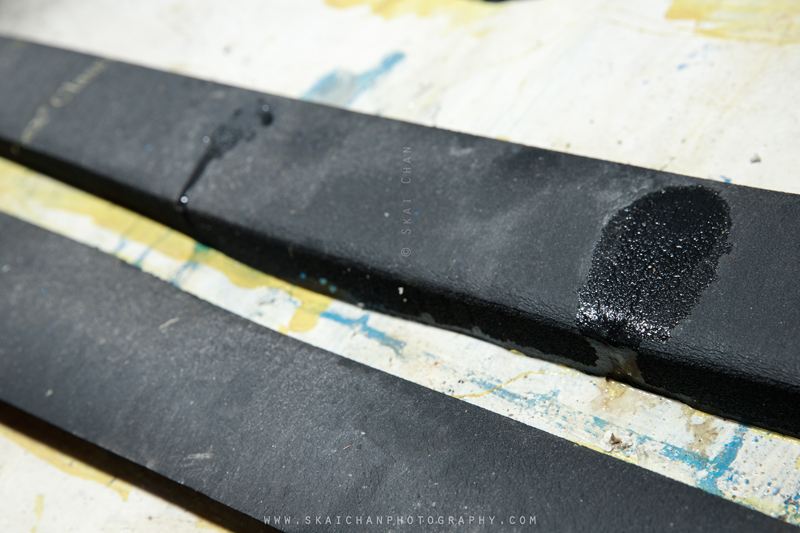
After the theatrical confrontation, the series changes to documentary photographs of the actual CCS riser. These images show the riser, insulated pipes, valves and visible moisture in the area. I included them because I didn't want the entire project to be interpreted as a fictional Halloween story. The decorations and dramatic poses are staged, but the cooling system and the problems I have been documenting are real. The sequence begins with a wider view to establish the location, then moves closer to the insulation and areas where moisture is visible.
One of my concerns is the unwanted heat exchange occurring along the CCS chilled-water piping. When I open a CCS riser, I can feel cool air coming from inside. To me, that is an indication that some of the cooling is escaping into the surrounding space instead of being used where it is needed. The visible condensation raises further questions about the effectiveness of the pipe insulation. As the surrounding air gains cooling from the pipes, heat is transferred towards the chilled water, potentially increasing the energy required to maintain its temperature.
Unlike a conventional split-unit air-conditioning system, where the refrigerant piping generally runs a relatively short distance between the outdoor condenser and the indoor unit, the CCS distributes chilled water through a much larger network of pipes and risers before reaching individual households. These pipes remain chilled around the clock, even when a particular household isn't actively using its indoor cooling unit. Furthermore, the CCS distribution infrastructure extends to households that have not subscribed to the service. This creates many opportunities for unwanted heat exchange along the distribution network, particularly wherever the insulation is inadequate.
I am not claiming that the total energy loss is necessarily enormous, because I don't have the measurements needed to quantify it. However, cooling the air inside a common riser serves no useful purpose for the residents. Even relatively small heat gains along individual sections of piping could add up across a large network operating continuously. That is why I find the persistent condensation and cool air inside the riser so troubling, especially after years of repair attempts. I believe the energy efficiency of the distribution system deserves closer examination rather than simply treating the visible moisture as an isolated cosmetic problem.
Photos 16–18: Learning to Save Myself
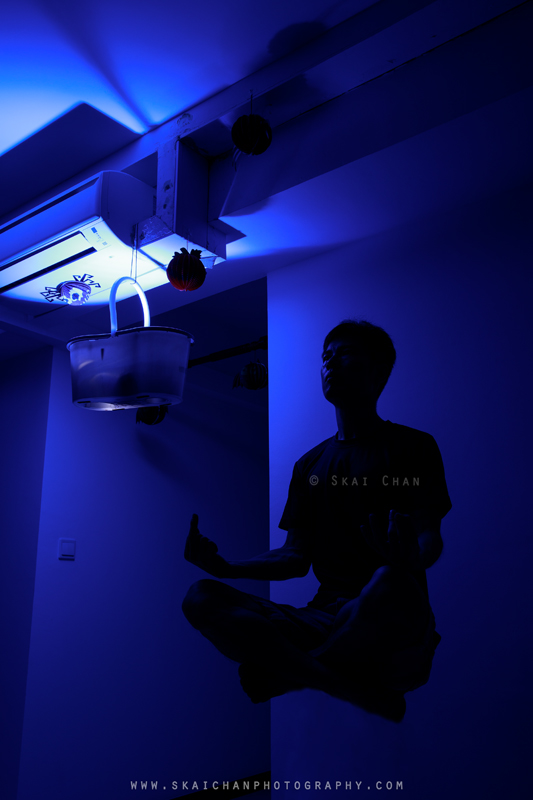
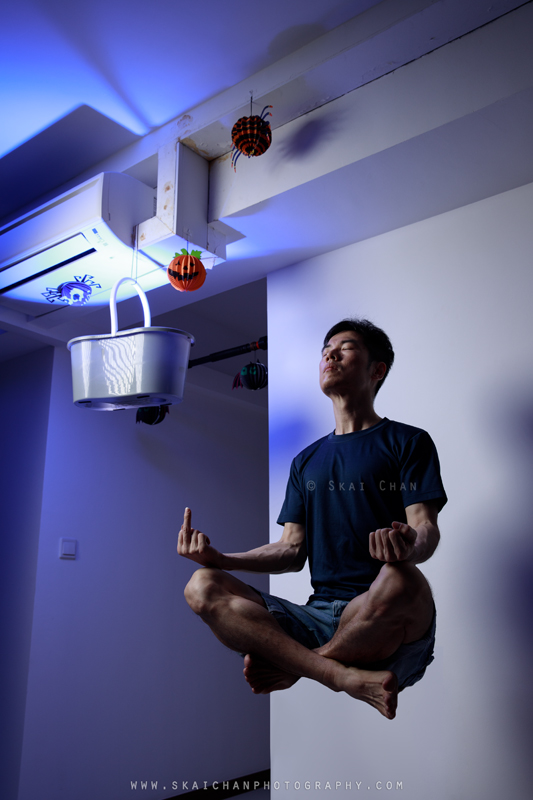
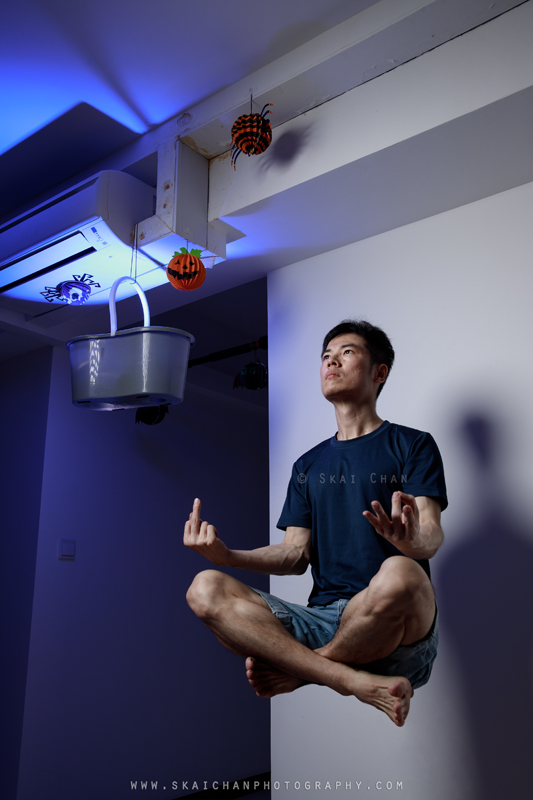
The story then moves inside my home, where I appear to levitate beneath the cooling unit, with the familiar bucket from the Giant mop set suspended nearby. My wife had repeatedly encouraged me to meditate, but my mind was too occupied by the CCS situation for me to concentrate properly. I didn't actually practise meditation as part of my recovery. Instead, the floating poses are an imaginary representation of the peace and mental control I wanted to achieve.
In reality, I sought help through psychological services, continued my regular Traditional Chinese Medicine (TCM) consultations, and spent considerable time reading about self-improvement and studying human psychology. I watched many videos about understanding people's behaviour, managing conflict and dealing with difficult situations. The photographs represent that process of learning rather than a sudden transformation. The progression from a dark silhouette to a more clearly illuminated figure, and finally to open eyes, suggests my attempt to regain awareness, perspective and control over my thoughts.
Photo 19: Still Hanging On
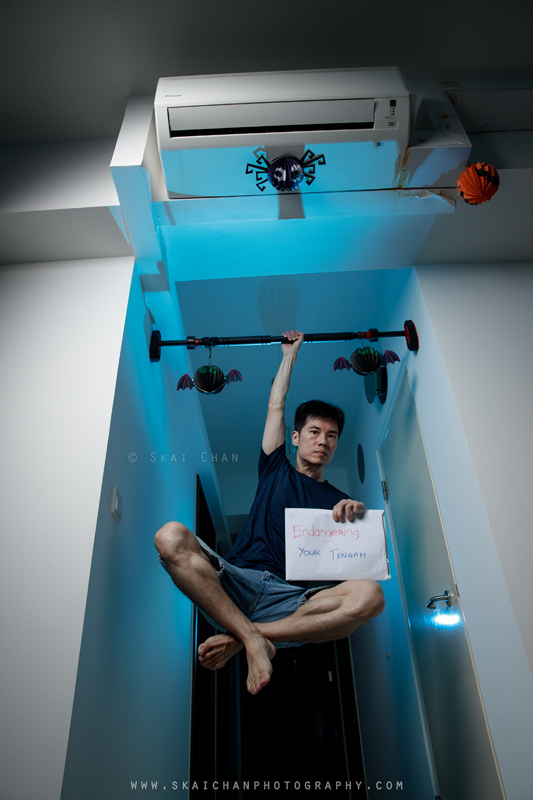
In this photograph, I hang from a pull-up bar with one hand while holding my handwritten protest sign with the other. The cooling unit remains above me, serving as a reminder of the unresolved situation. The pose is both literal and symbolic. I am trying to regain my former physical strength so that I can continue dealing with the challenges ahead. I know that I may not win the battle, but I don't want to give up on rebuilding my life and career. I also used blue lighting behind me as a separation light, both to distinguish my body from the background and to introduce a calmer mood after the unsettling green and red lighting in the corridor.
Photo 20: A Little Halloween Defiance
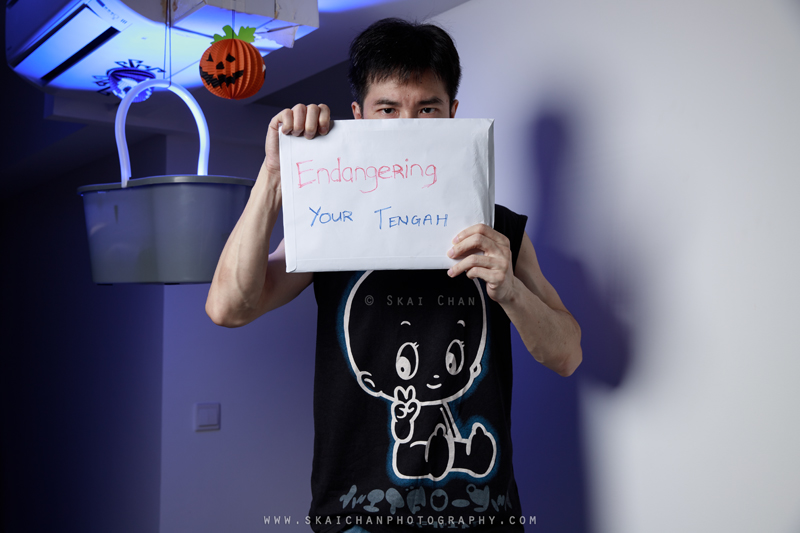
The final photograph shows me wearing a black singlet with a cute ghost illustration while holding the handwritten message "EndangeRing YouR TENGAH" across the lower part of my face. The message is my satirical response to the branding associated with the Tengah cooling system. My emphasis on "YOUR TENGAH" is deliberate: it is the residents who have to live with the consequences when something goes wrong. I have personally slipped on water from the CCS, and I still remember the waterfall incident from two Halloweens ago, when water near electrical installations made me fear the possibility of electrocution. Those experiences explain why I take the safety implications so seriously.
The contrast between the cute ghost and the serious experience behind the words is intentional. I wanted to end the series with a little dark humour rather than another photograph of despair. It isn't a declaration that the nightmare has ended, but simply my way of saying that I am still here, still expressing myself through photography and still trying to move forward.
Recycled Props, Hidden Meanings and Sustainability
I deliberately avoided buying new Halloween decorations for this project. After everything I had already spent in time, energy and money dealing with the CCS situation, I didn't feel that the Tengah CCS nightmare deserved another cent of unnecessary spending. I also wanted to avoid creating waste for a photoshoot that would last only two days, particularly when I had already witnessed so much material being used during repeated CCS repair attempts.
Halloween Decorations Donated by Thomson Lim
The Halloween decorations were kindly donated by Thomson Lim, a fellow Tengah resident whom I regard as something of a Tengah legend. He had cancelled his CCS subscription before moving in and incurred a financial loss in doing so. The decorations had already been used in previous years, and a few were torn, but that didn't bother me. They were still suitable for the photographs, and reusing them was much more meaningful to me than purchasing new decorations. My wife accompanied me when I went to collect the props from Thomson personally, and I'm grateful to both of them for helping make the project possible.
The Giant Bucket I Couldn't Throw Away
The bucket from a mop set purchased at Giant supermarket has a special place in this story. It was used during the earlier CCS leaking incidents and had become rather well known among residents who were active in the "Tengah CCS Issue" Telegram group. My wife had wanted to throw it away for a long time, but somehow, I kept hesitating. I didn't want to discard it until the CCS saga was finally over. Moreover, as long as the failed CCS system remains in my house, there's a day we would need the bucket to collect leaked water. Perhaps keeping it was my way of acknowledging that the problem remained unresolved, even though I would have preferred to forget the entire experience.
For this photoshoot, I suspended the bucket near the cooling unit and placed a blue-gelled light inside it. An ordinary household object associated with the leaks became one of the central props in my conceptual photographs. I suppose it was fortunate that I hadn't thrown it away after all, although I would much rather have had no reason to keep it.
The Pull-Up Bar I Kept Postponing
The adult fitness stations in my Tengah estate are rather infamous for being white elephants, and there's not even a single pull-up bar! I had raised the issue with HDB, but the discussion didn't lead anywhere. Eventually, I decided that I should install my own pull-up bar at home.
Unfortunately, the endless CCS problems kept delaying my plans. I expected that removing the failed cooling system would involve messy work and leave parts of my home dirty, so I thought it would be better to wait until the nightmare was over before installing anything else.
Little did I know how long this nightmare would drag on. Eventually, I realised that I couldn't keep putting my life on hold indefinitely. I bought and installed the pull-up bar so that I could start rebuilding my physical strength, regardless of what happened with the CCS.
Ironically, it became one of the most important props in this Halloween series. In Photo 19, I hang from it with one hand while holding my handwritten sign with the other. What started as a simple piece of fitness equipment became a symbol of my determination to regain my strength and move forward.
I had spent so long waiting for the CCS nightmare to end before moving forward. This time, I decided to move forward anyway.
The Recycled Envelope and Town Council Magazine
My handwritten "EndangeRing YouR TENGAH" sign was made from a large white envelope that I reused instead of buying new display material. Unfortunately, the envelope was too soft to remain upright on its own, so I eventually stuffed a town council magazine inside to make it firmer. I had regarded the magazine as rather wasteful and of little use to me, apart from occasionally using it to transport spiders out of my home. I was therefore amused that it finally served another practical purpose by supporting my handwritten message. The result was simple, inexpensive and effective, with a little irony thrown in.
Clothing and Colour Choices
For the corridor scenes, I wore a maroon shirt with my usual denim work shorts. The shirt represents the photography career I had hoped to develop after moving into Tengah. Under the green lighting, much of its original colour becomes less prominent, which also fits the idea of my ambitions being overshadowed by the CCS situation. Inside my home, I changed into my familiar navy-blue Skai Chan Photography shirt, which I had also used in an earlier Halloween project. It connects the photographs to my professional identity and creates continuity between the different chapters of my story.
The final black ghost singlet introduces a lighter Halloween mood while retaining the same personal message. I continued wearing my usual denim shorts throughout the series, reinforcing that the different characters and emotional states all belong to the same person.
Behind the Scenes: Two Exhausting Days of Photography
Although I appear in every conceptual photograph, I was also the photographer, lighting technician, art director and production assistant. I had to plan the scenes, prepare the equipment, position the props, operate the camera, pose and review the results myself. The photography took two days, excluding the time spent on preparation and post-production, and it was far more exhausting than the finished photographs might suggest.
Preparing the Equipment and Props
Much of the preparation involved digging through our bomb shelter to retrieve equipment and small accessories. I needed lighting equipment such as light stands, modifiers and colour gels, along with supplies such as tape, string and other items scattered among our stored belongings. The lighting modifiers included a snoot, reflector and softbox, while different gels were attached to speedlights or used with modifiers. I had to decide which tools would help me create the intended atmosphere while keeping unwanted light away from the surrounding areas.
Preparing the decorations was another time-consuming task. I had to position and secure the Halloween props, arrange the signs and consider how everything would appear from the camera's fixed viewpoint. I used gaffer tape rather than ordinary masking tape to secure some of the props, which made me particularly amused by the masking tape-like materials I had noticed inside the CCS riser.
Day One: Photographing the Corridor After Dark
I started the corridor photographs after dinner because I wanted relatively little ambient light. The darker environment allowed me to control the atmosphere more precisely using my own lighting. However, photographing myself was especially difficult. After setting the camera, I had to move to the intended position, pose, return to the camera and inspect the result. Without another person directing me, I couldn't easily tell whether my posture, expression or position was correct until after the photograph had been taken.
This resulted in many unsuccessful attempts. Even small differences in where I stood, how I angled my body or where I looked could affect the composition. I repeatedly adjusted the setup and tried again until the photographs were close to what I had imagined. Unlike photographing a client, where I can observe and guide the subject continuously, I had to become both the photographer and the person being directed.
The Motion-Blur Photographs Were Particularly Tricky
The opening photographs required precise timing during long exposures. I wanted recognisable figures at the starting and ending positions without recording too much movement between them. To achieve that, I had to move very quickly from one position to another. I actually moved backwards and almost hopped between the positions because I couldn't afford to waste much time during the transition. I repeated the process many times to get the positions and timing right. The finished photographs may look ghostly and effortless, but creating those translucent figures involved a surprising amount of rushing around the corridor.
A Shoot That Continued Past 1 am
The corridor session continued past midnight, probably until after 1 am. I was conscious that my neighbour's doorbell camera might have captured a great deal of my activity, although I don't know whether it actually recorded all those movements. This was the same neighbour who had previously gone to the trouble of finding an instruction manual to help me turn off the CCS riser valves during the waterfall incident, and I remain grateful for that assistance.
By the time I finished, my wife had already gone to bed. I tried to minimise the noise while preparing to shower, even using my phone's light to look for my shirt inside our master bedroom wardrobe because I couldn't switch on the ceiling lamp. Unfortunately, I still ended up disturbing her sleep. I was also extremely hungry after working for so many hours, so I had a late supper. Looking back, I realised that I hadn't been drinking enough water during the shoot, despite knowing that I should have kept myself hydrated, particularly while taking some TCM medication that I understood to be rather "heaty".
To make matters worse, I encountered an unexpected website problem related to my web host. After resolving it, I finally went to bed after 4 am. It was certainly not the kind of restful night I had hoped for after an exhausting photography session.
Day Two: The Home Studio Scenes
Despite sleeping so late, I had to wake earlier than usual for my regular TCM appointment and medication. To save money, I travelled by feet instead of taking public transport. I was already tired before beginning the second day's production. In the afternoon, I started planning and preparing the scenes inside my home. My wife helped by buying dinner so that I could concentrate on the photography without having to spend additional time travelling or washing dishes.
The home photographs involved different challenges from the corridor scenes. I had to arrange the suspended bucket, position the lighting, work around the cooling unit and carefully prepare the hanging and levitation compositions. Although I was working inside my own home, that didn't make the process particularly easy, especially when I had to handle everything myself.
The Painful One-Handed Hanging Photograph
The hanging photograph was particularly demanding because I had to hold my body weight with one hand while using the other to display the handwritten sign. I chose the camera's two-second self-timer rather than the ten-second option because I found the shorter countdown easier to judge. With a longer countdown, I would have had more difficulty predicting exactly when the shutter would fire, especially when there were so many things to remember.
I had to hold the envelope correctly, stop my body from swinging sideways, position my head, look towards the camera and raise my legs into a crossed position. Most importantly, I wanted the pose to look effortless, even though it was anything but. I repeatedly checked the camera's LCD screen to see whether the framing, posture and expression were correct. There were many unsuccessful attempts because I had too many things to coordinate within those two seconds, all while dealing with the physical discomfort.
It would have been much easier to hang with both hands, stabilise myself and then release one hand for the photograph. Unfortunately, I needed to hold the envelope before getting into position, so I couldn't do that. I also had to grip onto the middle section that didn't have cushion, to keep a distance from both of the bats. My palm became sore from repeatedly gripping and rubbing against the pull-up bar, and I couldn't wear gloves because they would have changed the appearance I wanted. Every unsuccessful attempt meant getting back into position and trying again. It was probably the most physically demanding scene of the entire project.
Creating the Levitation Photographs
Since I was already planning a photograph of myself hanging from the pull-up bar with crossed legs, I thought it would be interesting to create another scene in which I appeared to maintain a similar posture without holding on to anything. This composition also allowed me to show more of the unattractive CCS trunking above me, which has become such an unwelcome feature of my home. For the levitation photographs, I supported myself on a stool and later removed it during post-production. The floating effect was therefore created through a combination of careful positioning, photography and digital editing.
I experimented with different lighting treatments, beginning with a silhouette and progressing to photographs where my face and body were more visible. The blue light inside the suspended bucket added another unusual element to the scene. I was relieved to finish the second day's photography before midnight, particularly because I wanted to avoid disturbing my wife's sleep again after the previous night's experience.
Lighting and Photography Techniques
Lighting has always been one of my main interests as a photographer, and I wanted it to play an important role in this project. Rather than relying entirely on the existing room or corridor lighting, I deliberately shaped the atmosphere with flashes, modifiers and colour gels. The different lighting treatments also help distinguish the emotional stages of the story, from confusion and confrontation in the corridor to the calmer atmosphere inside my home.
Green and Red: Unease and Confrontation
In the corridor, green lighting creates an unsettling atmosphere around the CCS riser, while red adds a sense of danger and confrontation, particularly around the Halloween bat. I used modifiers such as reflectors and colour gels to direct the light and limit unwanted spill. Because the corridor is a shared residential space, I also had to consider the surrounding environment while preparing the photographs.
Blue: Calmness and Separation
Inside my home, I introduced blue lighting to create a different mood. Blue is a colour I associate with calmness, and it suited the photographs about learning, recovery and rebuilding strength. In the hanging scene, the blue light also served a technical purpose as a separation light, helping distinguish my body from the background. In the levitation photographs, a blue-gelled light illuminated the suspended bucket.
Self-Portrait Timing, Compositing and Post-Production
Unlike a conventional portrait session, I couldn't rely on someone behind the camera to direct my movements or tell me when my expression was right. I had to anticipate the camera's timing and repeatedly inspect the results. The series combines different techniques, including long exposures for ghostly movement, compositing for multiple versions of myself, and digital removal of the supporting stool in the levitation scenes.
The theatrical photographs are creative interpretations of my experience, while the six CCS riser photographs serve a documentary purpose. I wanted that distinction to remain clear, allowing the Halloween imagery to express my feelings while the documentary photographs show the actual conditions I observed.
Still Hanging On
When I first moved into Tengah, I imagined a very different future. I wanted to develop my photography, build a reliable home studio, create new work and improve our financial stability. I also hoped that doing so would give my wife and me the confidence to consider having a child. Instead, I spent years dealing with repeated CCS problems, uncertain repairs, disrupted assignments and an exhausting dispute. The effects went far beyond the cooling system itself, affecting my concentration, confidence, finances and plans for the future.
I have been trying to help myself through psychological support, TCM treatment, reading, learning and gradually rebuilding my physical strength. Recovery has not been a straightforward process, and I still have difficult days. Creating this Halloween series was exhausting too, requiring two days of photography involving elaborate lighting, posing and repeated attempts, not counting the preparation and post-production. But unlike the repeated CCS repair cycles, this was a project in which I could make creative decisions, solve photographic problems and eventually complete something meaningful.
I don't know whether I will ever receive the resolution or compensation I believe is fair, and no amount of repair work can simply return the time and opportunities I feel I have lost. Nevertheless, I want to keep developing my photography, regain my strength and move forward with my life. These photographs are not about defeating a Halloween monster or pretending that everything has become better. They are about trying to continue despite an unfinished struggle.
I still find myself asking difficult questions. Is there justice for ordinary residents who have suffered prolonged disruption? Will any government body step in to examine what happened and whether the affected homeowners have been treated fairly? Will those who promised me that they would follow up on my case during the previous General Election really keep their promises?
I don't know the answers, and that uncertainty is one of the reasons this experience has been so difficult to put behind me.
For now, I'm still hanging on.
After everything we've endured, we're still living without air-conditioning, through the heat, humidity and even the haze. The CCS may be switched off, but its consequences haven't disappeared. And despite everything, we're still hanging on.
Related Stories
- My Tengah CCS Experience — The detailed history of the cooling system problems, repair attempts and dispute.
- The Story Behind My Studio — Why establishing a reliable photography workspace mattered so much to me.
- My Previous Tengah CCS Halloween Photoshoot — The earlier conceptual series inspired by the CCS waterfall incident.
Acknowledgements
I must acknowledge that my creativity was greatly influenced by my diploma course. One particular module, facilitated by lecturer Jim Ang, encouraged me to explore my imagination and think beyond conventional ideas. I was also heavily inspired by my coursemate, Xin Kai, whose creativity encouraged me to explore new possibilities in my own work.
Thank you to Thomson Lim for donating the previously used Halloween decorations, and to my wife for accompanying me to collect the props, helping with meals and putting up with the disruption caused by my photography. I am also grateful to the neighbour who previously helped me find the instructions for shutting off the CCS riser valves during the waterfall incident, as well as everyone who has supported me through this difficult period.
My thanks also go to psychologists Magdeline and Moon for their support, and to Singapore Thong Chai Medical Institution and the TCM physicians, especially Miss Na, for the consultations, encouragement and treatment they have provided over the years.
Featuring ↬ Skai ChanHairstylist ↬ -Makeup Artist (MUA) ↬ -
Wardrobe ↬ Skai ChanCredits ↬ Thomson Lim
Camera ↬ Canon 6D Mark IILens ↬ Canon 24-70mm F2.8L IILighting ↬ Godox AD600BM, Godox V860-III, Godox V1mid
Place ↬ Home (Indoor)Date ↬ Year 2026
Photo Editing type ↬ Basic
Like what you see?
I spent hours uploading every album, and I hope they will inspire you.
Most of the people featured in my portfolio are everyday people rather than professional models. They may have started out with the same concerns many clients have: feeling camera-shy, unsure how to pose, or worried that they aren't photogenic. If they can look good in photographs, so can you.
Whether you're looking for photographs for yourself, your family, your business, or a special occasion, I'd be happy to discuss your ideas. If privacy is important to you, I also offer a Privacy Buyout option for eligible sessions.
Follow my Instagram & Facebook for more updates.
Related Photoshoots


Explore the Possibilities
Find Your Photography Session
Browse every portrait, commercial, event and specialist photography service available.
 Scan QR to visit this website
0%